
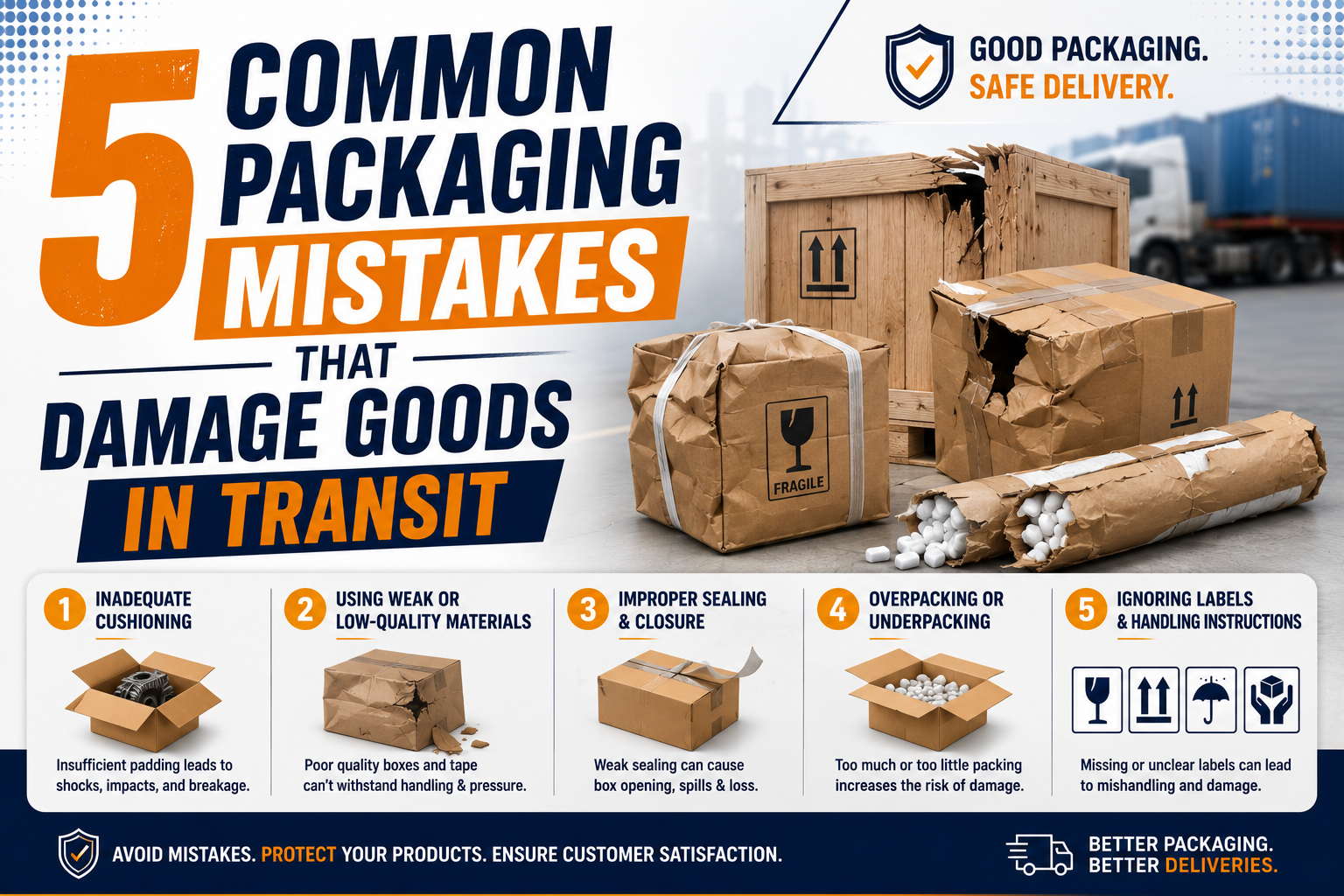
Transit damage claims almost never come down to one dramatic event. They come from small, repeatable packaging mistakes that add up over the length of a journey. Here are the five that show up most often.
1. Empty Space Inside the Box
Void space lets a product shift, and a shifting product turns every bump in transit into an impact. This is the single most common cause of preventable damage, and the fix is almost always cheaper than the claim: fill gaps with the right dunnage instead of assuming the outer carton alone will hold everything in place.
2. Under-Rated Carton Strength
Boxes are rated by burst strength and edge crush test (ECT) for a reason — a carton that looks fine on day one can fail after being stacked for weeks in a warehouse or container. Matching carton strength to the actual stack height and weight it will experience, not just the weight of the product itself, prevents the classic 'crushed bottom boxes' problem.
3. Wrong Orientation Labelling, or None at All
'This Side Up' and fragile markings only work if they're clear, placed on multiple faces of the package, and actually followed during handling. Relying on a single small sticker is effectively the same as not labelling it at all once a pallet gets rotated during loading.
4. Ignoring Humidity and Temperature on the Route
A shipment that's fine in a dry warehouse can develop condensation damage inside a sea container that crosses climate zones. This is especially common with metal parts, electronics, and moisture-sensitive materials, and it's avoidable with the right combination of barrier packaging, desiccant, or VCI protection matched to the actual route, not just the origin climate.
5. Treating Palletising as an Afterthought
Uneven load distribution, overhang beyond the pallet edge, and poor strapping are frequently the real cause of damage that gets blamed on 'rough handling.' A pallet load that's properly stacked, centred, and secured survives handling that would topple a poorly built one.


