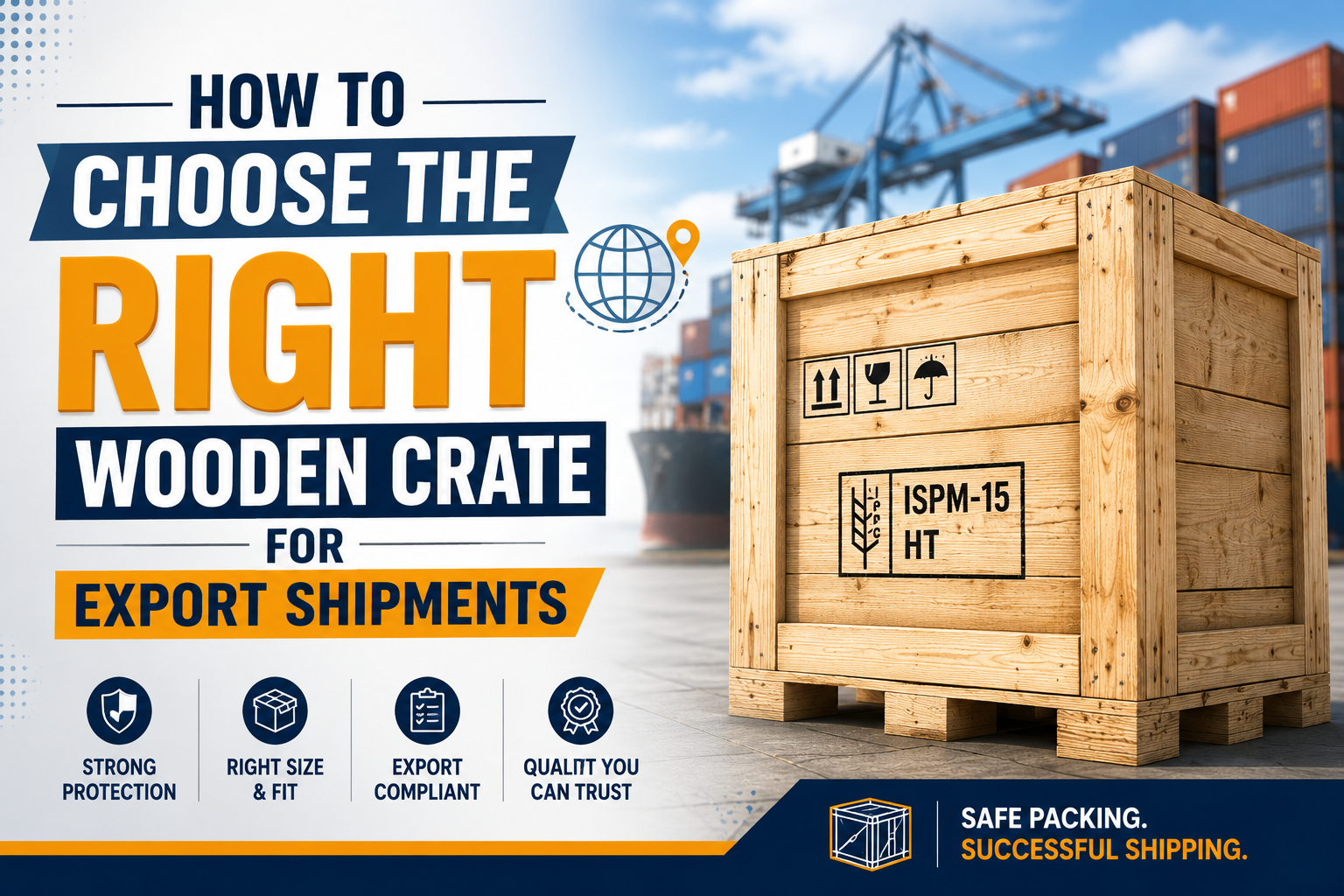
There is no single 'correct' wooden crate — the right build depends on what you're shipping, how it's travelling, and what it will go through before it reaches the buyer. Getting this wrong usually shows up as either wasted money on over-engineering, or damaged goods from under-engineering.
Start With the Product, Not the Crate
Before choosing timber thickness or crate style, nail down three things: the weight and centre of gravity of the item, whether it's fragile or rigid, and whether it can tolerate being tipped or must stay upright throughout transit. A CNC machine and a batch of finished furniture need completely different structural approaches even if they weigh the same.
The Common Crate Styles
- Open crates: Skeletal frames used for large, rigid, non-fragile items like structural steel or machinery bases where full enclosure isn't needed.
- Closed/sheathed crates: Fully panelled with plywood, used when the product needs protection from weather, dust, or tampering during transit.
- Heavy-duty skid crates: Built on a reinforced base skid for forklift and crane handling, standard for industrial machinery and equipment.
- Barrier-lined crates: Add a moisture and vapour barrier film inside a closed crate, used for electronics and metal components sensitive to humidity.
Matching Transport Mode to Crate Strength
Sea freight involves the most handling stress — multiple crane lifts, stacking in the hold, and weeks of vibration and humidity exposure. Crates for ocean shipments are typically over-engineered compared to what a domestic truck delivery would need. Air freight, by contrast, prioritises weight reduction since freight cost scales directly with mass, so crate design leans toward lighter timber and optimised bracing rather than maximum strength.
Internal Bracing Matters More Than the Outer Box
A well-built outer crate with no internal restraint is still a liability — the product shifts inside, and repeated impact against the crate walls during transit causes most of the damage that gets blamed on 'weak packaging.' Cross-bracing, cradle supports shaped to the product, and anti-shift blocking inside the crate typically matter more than adding extra plywood thickness on the outside.
What to Share With Your Supplier
- Exact dimensions and weight of the item, including any protrusions
- Centre of gravity if it's asymmetric
- Handling method at both ends (forklift, crane, manual)
- Number of transhipments and total transit time
- Any humidity or corrosion sensitivity
Share these details upfront and a good packaging partner can usually recommend the right crate style and timber spec in a single conversation, instead of a back-and-forth after something arrives damaged.